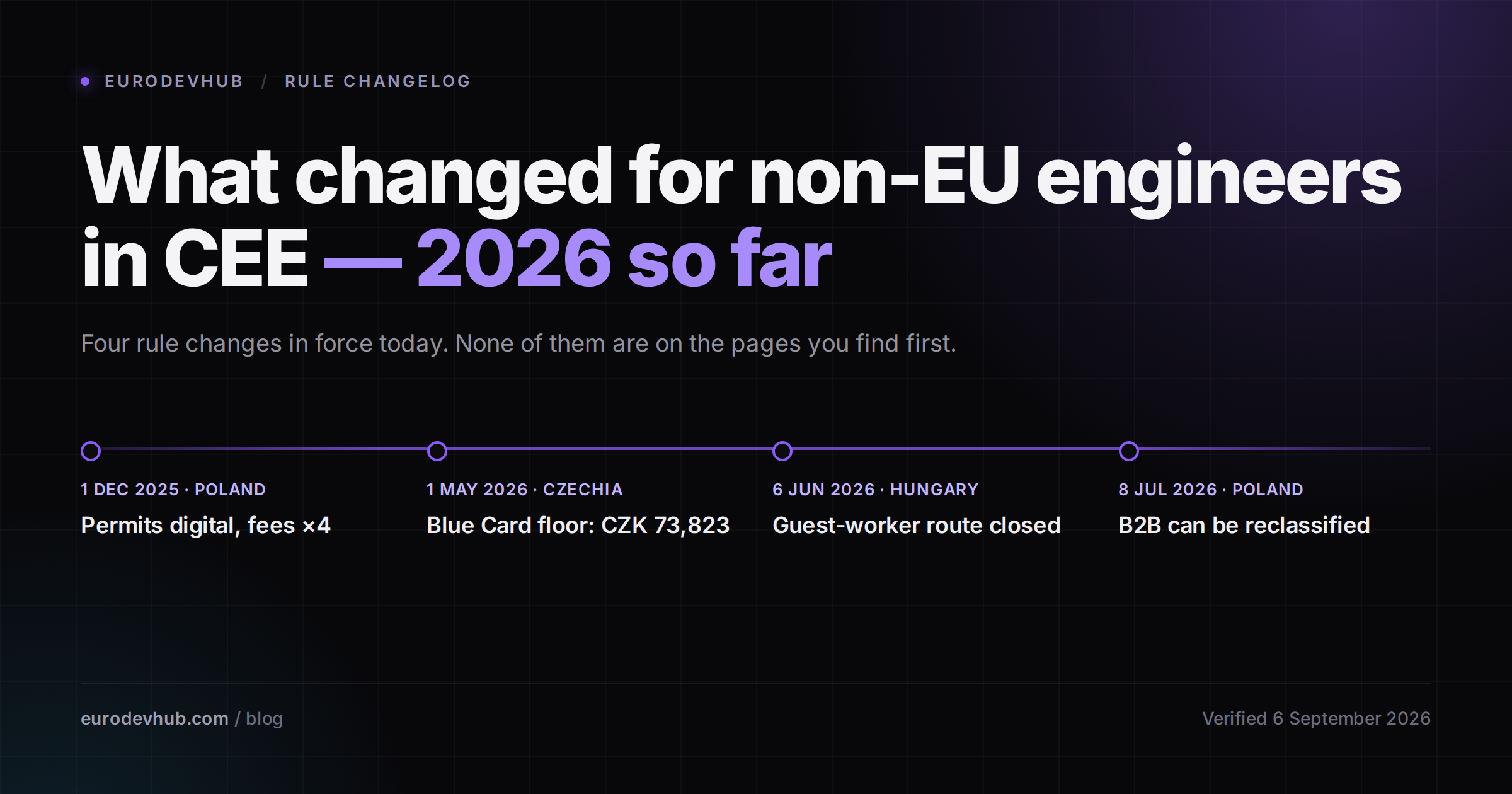
Four things changed for non-EU engineers in Central and Eastern Europe between January and September 2026. One raised the salary you need. One made a common contract type risky. One closed a route entirely. One quietly removed the paperwork. All four are in force today, and none of them are reflected on most of the pages that come up when you search for them. Verified against primary sources on 6 September 2026.
Czechia raised the Blue Card floor to CZK 73,823
Since 1 May 2026 the minimum gross monthly salary for an EU Blue Card in Czechia is CZK 73,823, roughly EUR 3,000. That is a 6.6% increase over the previous floor. If you are negotiating a Prague or Brno offer right now and the number on the table is below that, the permit does not exist — no amount of employer goodwill changes it.
Two details that matter more than the number. First, the threshold that applies is the one in force on the day your application is filed, not the day you signed. An offer negotiated in April and filed in June is judged against the new floor. Second, several aggregator pages still quote CZK 77,245 for 2026 — that was a projection published before the actual decree, and it was wrong. If a recruiter quotes you that figure, they are reading a forecast.
Czechia also launched a digital "Foreigner Account" alongside the change, which is the first serious attempt in the region to put the whole permit file online.
Poland's labour inspectors can now reclassify your B2B contract without going to court
This is the biggest one, and the one least likely to reach you through a recruiter. Since 8 July 2026, Poland's labour inspectorate (PIP) can issue an administrative decision declaring that a B2B arrangement is in fact an employment relationship. Before that date, the inspectorate had to sue. Now it orders, and if the order is ignored, the district inspector decides.
The decision applies going forward, from the day it is issued — establishing employment for past periods still requires a court. There are 30 days to appeal to the labour court. But the exposure behind it is the part worth understanding: once an arrangement is found to be employment, back social contributions and tax can be claimed for up to five years.
A large share of senior engineering roles in Poland are structured as B2B. The contract type did not change on 8 July. What changed is how cheaply someone can challenge it.
If you are on B2B in Poland, the practical question is not "is this legal" — it is whether your arrangement looks like employment on paper: fixed hours, a single client, a manager in the org chart, company equipment, no ability to send a substitute. Those are the markers. If most of them describe you, ask your employer what their position is before you renew.
Hungary closed the guest-worker route
Hungary stopped accepting new guest-worker residence permit applications on 6 June 2026, under Government Decree No. 92/2026. Applications filed by 5 June with the fee paid are still being processed. Existing holders keep their rights and can still extend or have the permit reissued under the old rules.
For most engineers reading this, the route was already irrelevant — since December 2024 it only covered nationals of Armenia, Georgia and the Philippines, and it never counted toward permanent residence. The reason it matters is what it signals. Hungary has ordered a broader legislative review of foreign employment, with no replacement pathway announced. If Budapest is on your shortlist, treat the rest of 2026 as unsettled and get the permit type confirmed in writing before you resign anywhere.
Poland's permit process is now fully digital — and more expensive
Since June 2025 all work permit and declaration applications in Poland go through praca.gov.pl, and paper is no longer accepted. From 1 December 2025 the fees roughly quadrupled for declarations, from PLN 100 to PLN 400, with work permits at PLN 200 for stays up to three months and PLN 400 above that. Georgia dropped off the simplified declaration list on the same date; Armenia, Belarus, Moldova and Ukraine remain.
Digital does not mean fast. The statutory deadline for a residence card in Poland is 60 days. The number people in Warsaw actually report is nine to fourteen months. Plan your move around the second number.
What to do with this
If you have an offer in hand: check the salary against the threshold in force on your likely filing date, not today's. If you are on B2B in Poland: read your contract against the reclassification markers and raise it at renewal, not after. If you are choosing between countries: weight the real processing time far above the statutory one, and discount any country currently rewriting its rules.
See jobs with visa sponsorship in Poland
Learn moreSources
Czech Blue Card threshold: Ministry of the Interior decree, in force 1 May 2026. Poland B2B reclassification: amendment granting PIP administrative decision powers, in force 8 July 2026. Hungary: Government Decree No. 92/2026, effective 6 June 2026. Poland fees and procedure: Act on Employment of Foreign Nationals, changes effective 1 June 2025 and 1 December 2025. All figures verified 6 September 2026. Nothing here is legal advice — confirm your own case with the authority handling your file.